Are you moving to another country, studying abroad, or expanding your business internationally? You've probably heard that your documents need to be The Hague Handbook. But what exactly is this seal, and why might your translation be worthless without it?
In this article, the team at GG Algarve Translations explains everything you need to know to avoid bureaucracy and ensure that your paperwork is accepted on the first attempt.
What is the Hague Convention?
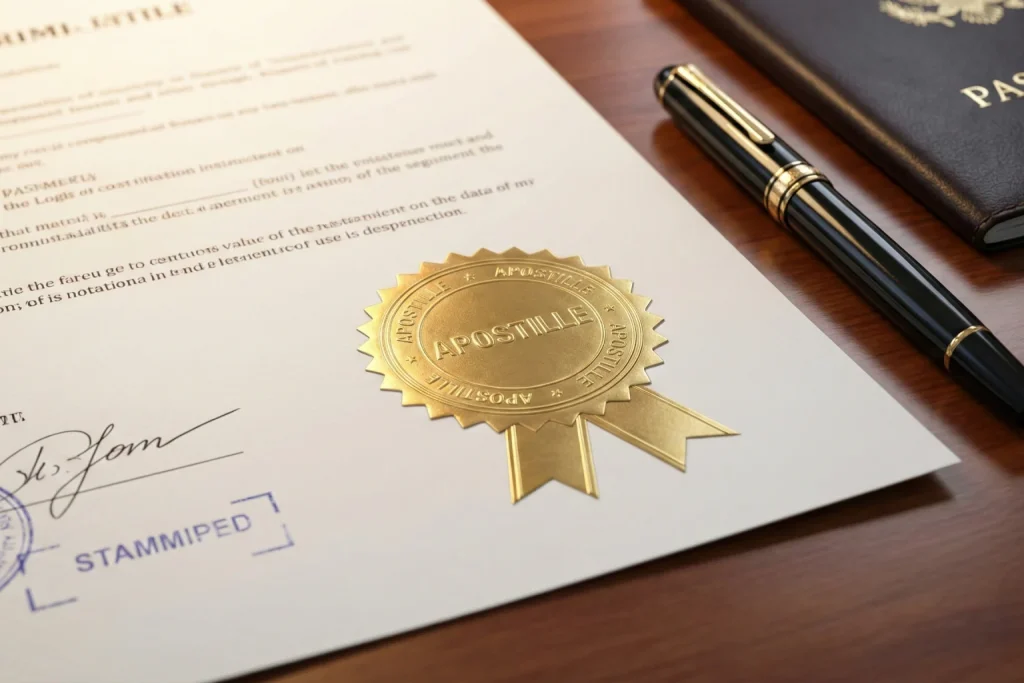
The Hague Apostille is a certificate of authenticity issued by countries that are signatories to the Hague Convention. In practice, it is an official "stamp" that guarantees that a public document (such as a birth certificate, diploma, or power of attorney) issued in one country is true and valid in another country.
Prior to this convention, the legalization of documents was a lengthy process involving several consulates and ministries. The Apostille simplified everything into a single administrative act.
When do you need to apostille a document?
Generally, you will need the Apostille whenever you have to present an official Portuguese document in a foreign country (or vice versa). The most common cases include:
- Citizenship Applications: To validate birth certificates and criminal records.
- Studies and Universities: For recognition of university degrees and transcripts.
- Wedding Abroad: For civil status and marriage certificates.
- International Business: For company bylaws, powers of attorney, and notarized minutes.
Does a Certified Translation require an Affidavit?
This is the most common question we receive. The answer is: It depends on the destination country.
Often, it is not enough to simply translate the document. If the country to which it is being sent requires the Apostille on the original document, it is very likely that it will also require that the translator's or notary's signature that certified the translation is apostilled.
The correct process usually follows this order:
- Obtain the original document.
- Certify the original (at the Attorney General's Office or competent authority).
- Do the Certified Translation of the document and the Workbook itself.
- (Optional) Certify the final translation if the destination country explicitly requires it.
⚠️ Avoid Common Mistakes
A very common mistake is to translate the document. before to submit the original Workbook. If the Workbook is not translated, foreign authorities may reject the application, forcing you to spend twice as much money to redo the translation. Bring the apostilled document first!
Where can I obtain the Workbook in Portugal?
In Portugal, the competent authority for issuing the Apostille is the Attorney General's Office (PGR). There are customer service centers in Lisbon, Porto, Coimbra, Évora, Madeira, and the Azores.
How can GG Algarve Translations help?
Dealing with international bureaucracy can be stressful. At GG Algarve Translations, We don't just do the translation; we guide our clients through the entire legalization process so that nothing goes wrong.
- Full Translation: We have accurately translated the content and stamps/seals in the Workbook.
- Legal Validity: Our translations are certified and ready to be presented to notaries and lawyers.
- Free Consultation: We help you understand whether your specific case requires additional steps.
Don't risk having your important documents rejected. Talk to experts who understand the law.